
Znu AI Strategy Portal
A conversational strategy partner that already understands European business.
When the question is “What should we do next?” — about a new market, a competitive response, a pricing decision — most growing European companies don’t have the resources of a McKinsey retainer or a fractional CMO sitting in the next room. The AI Strategy Portal exists for that gap.
The Portal is not a chatbot bolted onto a generic large language model. It is a structured reasoning environment, calibrated specifically for European SME realities, with thirty years of go-to-market consulting practice encoded as inferential discipline. You ask a real strategic question. You get back a working document, presentation, or spreadsheet — something you can take into a meeting, not a wall of generic advice.

How the Portal Works
The Portal orchestrates frontier AI models — currently the user can select either Claude (Anthropic) or Mistral — through a proprietary layer of business methodology. The methodology is structured, conflict-resolved, and stage-gated: it knows which strategic frameworks apply at which stage of business maturity, and it suppresses advice that would be miscalibrated for your size.
Most generic AI tools, asked for a channel strategy, will return advice calibrated for an enterprise with a brand team, an agency relationship, and an eighteen-month awareness campaign budget. That advice is not wrong. It is miscalibrated for a company with a €15,000 marketing budget and two sales reps.1 The Portal applies an EU SME filter before generating any recommendation, so the advice you receive is shaped for the resources you actually have.
Multiple models work in parallel because no single AI system is uniformly best. Some questions get sharper answers from Claude’s analytical reasoning. Others benefit from Mistral’s European training corpus. The Portal handles the routing so you don’t have to think about it.
All processing stays on EU infrastructure where the customer selects EU-only inference. Where US-based inference is used, transfers occur under Standard Contractual Clauses with documented zero-training commitments from the provider. Your queries are masked from upstream providers — they cannot associate your conversations with your identity.
What a Portal Session Looks Like
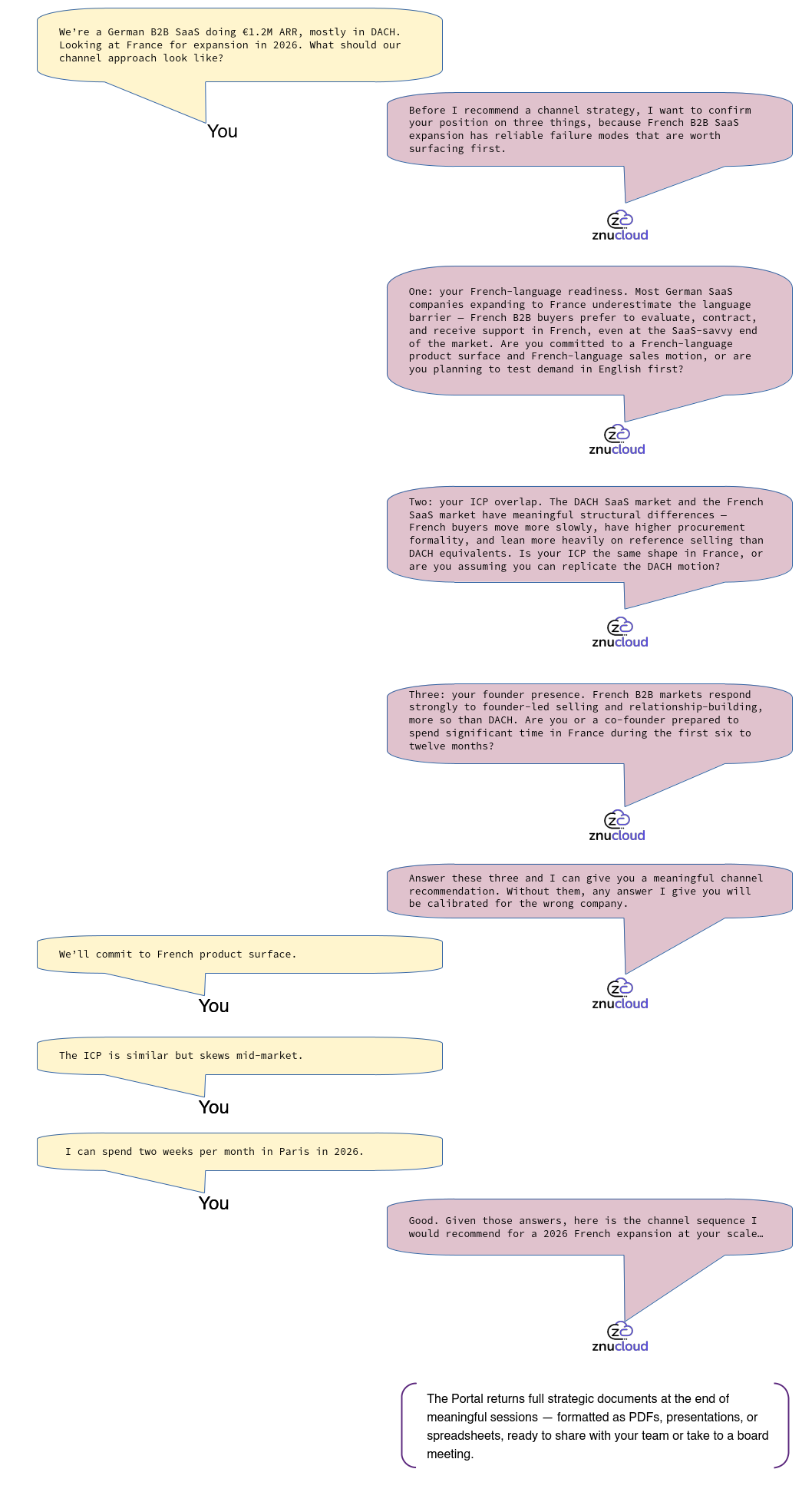
A conversation with the Portal is structured but feels natural. Here is a fragment of a real session:
What You Use It For
Go-to-Market Planning
New market entry is where AI strategy tools fail most often, because the question demands more context than any generic model can hold. The Portal handles GTM questions with frameworks that distinguish between channel selection (which paths to market), channel sequencing (which order to test them), and channel saturation (when to add another). This sequencing discipline is the most common gap in early-stage GTM thinking, and it is the most expensive gap to discover by trial.2
A typical GTM session works through your target market definition, your ICP refinement, your differentiation positioning, your channel hierarchy, and your first six months of execution priorities. The output is a working document with named frameworks (Crossing the Chasm, Diamond Positioning, GOST), specific channel recommendations, and a sequenced execution plan you can hand to your team.
Pricing Strategy
Pricing is where European SMEs most often leave money on the table — typically by underpricing relative to market and value, often by 30-50%.3 The Portal handles pricing work through multiple lenses: cost-plus floor calculation, value-based ceiling estimation, competitive positioning, and the psychological pricing tactics that change conversion at the margin.
A pricing session can range from a quick “are we leaving money on the table at this price point” sanity check to a comprehensive pricing redesign for a new product launch. The Portal will surface the questions you need to answer (what is your willingness-to-pay distribution, what is your competitive anchoring, what is your value-per-customer asymmetry) before generating recommendations. You get back a structured pricing analysis with defended numbers, not a “have you considered raising prices?” hand-wave.
Competitive Analysis
Most competitive analysis fails because it stays at the feature comparison level. The Portal works at three layers: what your competitor does (features, pricing, positioning), what your competitor cannot easily do (structural constraints, strategic commitments, organizational limitations), and what your competitor will do next (pattern-based prediction from observed behavior). The third layer is where competitive analysis becomes actually useful for decisions.
A competitive session typically produces a SWOT matrix against named competitors, a positioning map showing your defensible territory, and a recommended response strategy. Output is a working document your sales team can use in deal-by-deal positioning conversations, not a one-time deck that gathers dust.
Privacy and Control by Architecture
The Portal is designed so your strategic conversations are yours alone:
- Zero training on your content. Your queries are never used to train AI models — not ours, not the upstream providers’. This is contractually guaranteed in our agreements with Anthropic and Mistral.
- Zero retention after session end. When your session closes, the conversation is gone from our systems. We don’t retain transcripts, we don’t index them for analytics, we don’t keep copies for “product improvement.”
- Customer-controlled continuity. If you want to continue a conversation later, the Portal can export your session to a markdown memory file you save locally. Upload it next session to resume. You hold the file; we don’t.
- EU data sovereignty. Where you select EU-only inference, your queries never leave EU infrastructure. Where US inference is used, transfers are governed by Standard Contractual Clauses with zero-training commitments.
Most AI vendors retain conversations to improve their products. We chose the opposite architecture because strategic conversations are the kind of content that should not accumulate as a liability on someone else’s servers.
Who This Is For
The AI Strategy Portal is built for founders, owners, CMOs, and strategy leaders at growing European companies. The buyer is typically someone who has been making strategic decisions with limited support — a board meeting once a quarter, a fractional advisor who is rarely available, a consulting firm whose retainer is too expensive to engage for the smaller questions.
If you have already worked with strategy consultants, you will recognize what the Portal does. If you have not, you will discover that good strategic thinking is more about asking the right questions than producing the right slides. The Portal is built to ask the right questions.
Pricing is the same across products at every tier, with annual billing saving 20%. See pricing →
The miscalibration problem is structural. AI models train on documented business cases, and documented business cases skew heavily toward enterprises with marketing budgets that produce case studies, white papers, and industry coverage. The actual EU SME marketing budget distribution has no published equivalent. See European Commission, Annual Report on European SMEs 2024/2025 on SME marketing budget realities. ↩︎
Channel sequencing as a discipline is most thoroughly articulated in Moore, Geoffrey A., Crossing the Chasm, 3rd edition (HarperBusiness, 2014), particularly the chapter on the bowling alley strategy. The framework is forty years old but the sequencing errors it describes recur reliably across new SaaS markets, including the current AI tooling segment. ↩︎
Pricing under-realization in B2B SaaS is documented across multiple studies. Patrick Campbell’s ProfitWell pricing research consistently finds that B2B SaaS companies under-price by 30-50% relative to willingness-to-pay, with European SMEs at the wider end of that distribution due to lower cultural comfort with price increases. See ProfitWell pricing studies for the underlying methodology. ↩︎